




News / Analysis
AnalysisIvan Pace Jr. and Run Defense: What to Watch
A viewing guide to run fits and linebacker decisions, not a claimed charting study.
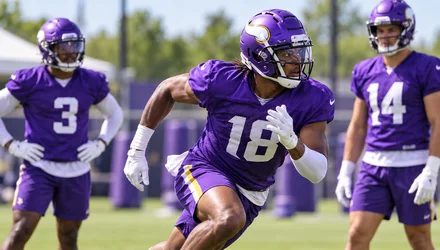
Ivan Pace Jr.’s run defense is easier to appreciate on a replay than in a box score. A linebacker can do his job perfectly and never touch the ball carrier, or make a tackle that hides a mistake earlier in the play. This guide explains how run fits work, what the Week 1 numbers against Green Bay show, and what to watch as the Vikings head to Chicago.
Evaluating a linebacker takes more than counting tackles. For Ivan Pace Jr., start with the official player profile and statistics, then examine individual plays in context.
Run fits and gap responsibility, explained
Every run has gaps: the spaces between and outside the offensive linemen. Coaches label them with letters, starting with the A gaps on either side of the center and moving outward to the B, C and D gaps. A sound run defense puts one defender in charge of each gap, so that wherever the back tries to go, someone is already there.
A linebacker’s "fit" is how he gets to his gap. He reads his keys, usually the guards and the backfield, then steps into his assigned space before a blocker can seal him out of it. Some defenders are asked to take on a blocker and force the runner back inside; others are asked to "spill" the play outside toward help. If one player leaves his gap, even to chase the ball, a cutback lane can appear behind him.
That is the central tension for any aggressive linebacker. Attacking fast can blow a run up in the backfield. Attacking the wrong gap can turn a two-yard run into a big play.
Read the assignment before judging the result
Track the offensive formation, the direction of the blocking and the linebacker’s first steps. A defender can influence a run by closing an available gap even when a teammate makes the tackle. Conversely, a tackle several yards downfield does not by itself show that the initial fit was sound.
How offenses attack a linebacker
Offenses build run plays to put linebackers in conflict. Outside zone stretches the defense sideways and waits for a gap to open as defenders flow. Counter and other gap schemes pull a guard or tackle across the formation, asking the linebacker to read the puller quickly without abandoning his own gap. Double teams at the line are designed to push a defensive lineman back and then let one blocker climb to the second level.
The pass game is part of the same problem. A linebacker who fills fast against the run is the defender a play-action fake is designed to pull forward. Good run defense is not just speed to the ball; it is speed with the right read.
Week 1 against Green Bay: what the box score shows
In the Vikings’ 39-22 win over the Packers, ESPN credits Pace with three tackles, all solo, including one tackle for loss. The play-by-play shows where they came from. In the second quarter, on 2nd-and-5, MarShawn Lloyd ran left end and Pace brought him down for a loss of two yards; that drive ended in a 43-yard Green Bay field goal. His other two tackles came on fourth-quarter kickoff returns by Kaleb Johnson, of 25 and 27 yards.
As a unit, the defense held Green Bay to 66 rushing yards on 21 attempts, 3.1 yards per carry, with three rushing first downs. Lloyd had 13 carries for 37 yards, and Chris Brooks had 7 for 29. Blake Cashman led the linebackers with seven tackles, two tackles for loss and half a sack, while Byron Murphy Jr. led the team with eight tackles. On a pivotal fourth-and-1 late in the game, Jordan Love was stopped for no gain, with the tackle credited to Domonique Orange.
Those numbers need context. The Packers threw 42 passes and Love finished with 387 passing yards, so the run game was not where Green Bay did most of its damage. The data also does not include snap counts or assignments, so it cannot show how often Pace was on the field on running downs or which gaps he was responsible for. Team and position totals are on the Vikings defensive stats page.
A repeatable review
For each play, record game and quarter, down and distance, formation, visible blocking direction, contact point and outcome. Keep uncertain assignments marked as uncertain: the broadcast angle does not reveal the defensive call. Review comparable plays before describing a season-long pattern.
This is an editorial framework for watching Pace, not a completed film chart or a claim about his measured win rate.
Ivan Pace Jr. run defense: what to watch at Chicago
Minnesota visits the Bears on September 20 after Chicago opened with a 59-37 win over Carolina. An ESPN Week 2 column asked whether Ben Johnson can solve Brian Flores’ Vikings defense. For Pace specifically, four things are worth tracking:
When he is on the field. Note the down, distance and offensive personnel on his snaps. The Vikings depth chart shows the listed order, but game usage can differ.
His first step. Watch whether he reads the guard and fills downhill, or waits for the back to declare.
Cutback discipline. On runs away from him, check whether he stays behind the ball or overruns the play and leaves a lane.
Special teams. Two of his three Week 1 tackles came on kickoff coverage, so that phase is part of his role worth following.
Updated September 16, 2026, with Week 1 context. Editorial explainer by Minnesota Vikings IO. Game statistics come from ESPN’s Week 1 box score and play-by-play; coverage calls, assignments and snap counts are not recorded there and are not claimed here.